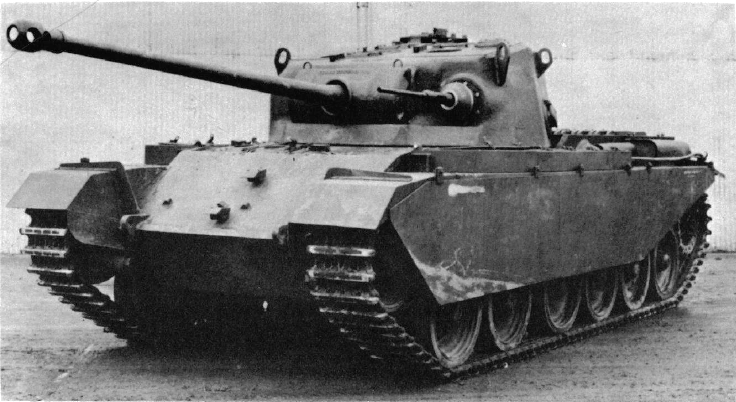
In 1945, Britain sent six prototype tanks to Belgium to join the fight in the final weeks of World War II. They arrived too late. The war in Europe ended before a single one of them fired a shot. That tank was the Centurion. And it turned out that missing World War II was the least interesting thing about it.
Why Britain Needed Something New
By 1943, British tank design was a mess. The Army had two separate categories of tanks — infantry tanks that were slow and heavily armoured, and cruiser tanks that were fast but thin-skinned. Neither type was doing the job well enough. Germany’s Tigers and Panthers were outgunning both.
That is when the War Office decided to stop splitting tanks into two categories and build one tank that could do everything. It needed to be fast enough to maneuver, armoured enough to survive a hit, and armed with a gun that could actually kill what it was facing. The project was given the designation A41 and started development in 1943.
The result was the Centurion.
What Made It Different
The Centurion came in at around 50 tons, similar weight to the Black Prince that was being developed at the same time. But where the Black Prince kept the same underpowered engine from the Churchill, the Centurion got something completely different.
Its engine was the Rolls-Royce Meteor. And that name has an interesting story behind it.
The Meteor was directly based on the Rolls-Royce Merlin — the same engine that powered the Spitfire and the Hurricane. Engineers stripped out the supercharger that the Merlin needed for high-altitude flight and fitted it into a tank. The result was a 600 horsepower V12 that gave the Centurion a top speed of around 21 mph. Not fast by car standards, but significantly better than anything Britain had put an infantry tank engine in before.
Here is what the Centurion looked like on paper:
- Main gun: QF 17-pounder (same as the Black Prince and Sherman Firefly)
- Armour: Up to 152mm at its thickest points
- Weight: Around 50 tons
- Engine: Rolls-Royce Meteor V12 — 600 horsepower
- Top speed: 21 mph on roads
Same gun as the Black Prince. More armour than the Black Prince. Faster than the Black Prince. That is why the Black Prince never went into production.
Too Late for WW2, Just in Time for Everything Else
The six prototypes arrived in Europe in May 1945. The war ended days later. So the Centurion, like the Black Prince before it, never fired a shot in the war it was designed for.
However, the British Army adopted it anyway. And that is where the story gets interesting.
In 1950, North Korea invaded South Korea. British forces deployed with Centurion Mk.3s. The tank immediately proved itself. At the Battle of Imjin River in April 1951, a regiment of Centurions supported the British 29th Infantry Brigade as Chinese forces tried to break through UN lines. The Centurions held their ground for three days and helped stop the advance cold.
It was the beginning of a very long career.
The Tank That Refused to Retire
Between 1946 and 1962, Britain produced 4,423 Centurions across 13 different versions. Dozens of countries bought them. And many of those countries kept using them for decades.
The list of conflicts the Centurion fought in is longer than almost any other tank in history:
- Korean War (1950-1953)
- Suez Crisis (1956)
- Indo-Pakistani Wars (1965 and 1971)
- Six-Day War and Yom Kippur War (1967 and 1973)
- Vietnam War — used by Australian forces
- South African Border War (1970s-1980s)
The last Centurions were retired from frontline service in some armies in the 1990s. A tank designed in 1943 was still doing its job fifty years later. Not many pieces of military equipment can say that.
What the Centurion Got Right
The reason the Centurion lasted so long comes down to one decision made early in the design process. Britain stopped asking “what category does this tank fit into” and started asking “what does a good tank actually need to do.” The answer — move, survive, and kill — was the same whether you were in Korea in 1950 or the Middle East in 1973.
That is also why the Centurion made the Black Prince irrelevant before it even finished testing. They were solving the same problem. The Centurion just solved it better.
Six prototypes arrived too late for World War II. Over four thousand more went on to fight in almost every major conflict for the next four decades. Not a bad career for a tank that missed its first war entirely.