By the winter of 1944, American tank crews knew the truth. Their M4 Shermans were outgunned. German Tigers and Panthers could knock out a Sherman at over 1,000 meters. The Sherman struggled to return the favour even at half that range.
What most people don’t know is that America already had the answer sitting in a development program. It was called the M26 Pershing. And the story of why it almost never made it to the front lines is just as interesting as the tank itself.
What Was the M26 Pershing?
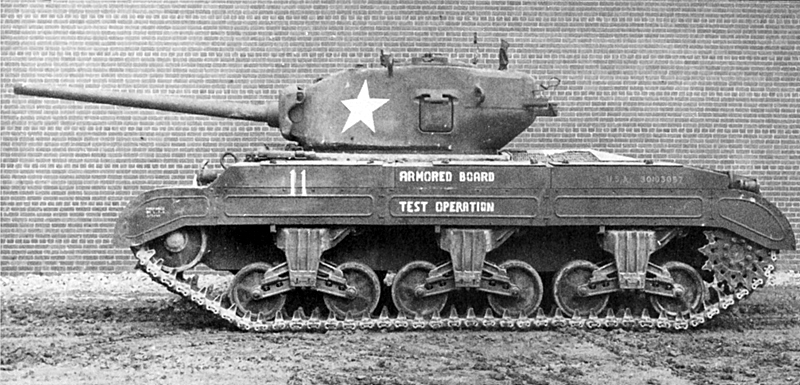
The Pershing was the U.S. Army’s first true heavy tank. Compared to the Sherman it was meant to replace, it was a different beast entirely.
- Main gun: 90mm M3 — capable of punching through the front Armour of a Panther
- Weight: 41,900 kg (the Sherman weighed around 30,000 kg)
- Armour: 115mm on the front hull — nearly double the Sherman’s protection
- Crew: Five men
- Engine: Ford GAF V8 gasoline, top speed around 48 km/h
It was also named after General John J. “Black Jack” Pershing, the commander of American forces in World War I. The name fit — the Pershing was built to dominate.
So Why Didn’t It Show Up Earlier?
Here’s where it gets frustrating, at least if you were an American tank crewman in 1944.
The M26 wasn’t a sudden invention. Development had been ongoing since the early 1940s. Prototypes existed. The Army knew the Sherman had limits. But the man who controlled what equipment reached the battlefield, General Lesley McNair of Army Ground Forces, believed heavy tanks were unnecessary. His argument was that tank destroyers which was faster, lightly armoured vehicles, would handle enemy armour. Tanks were for exploitation and speed, not slugging matches. Not only that bigger tanks meant less tanks the ships could carry at once.
So the Pershing sat in development limbo while Shermans burned across France.
The Battle That Changed Everything
On December 16, 1944, Germany launched its last major offensive in the west. The Battle of the Bulge threw roughly 400 Panther tanks, Tiger IIs, and other heavy armour directly into American lines.
The results were brutal. Sherman after Sherman was knocked out at ranges they could not effectively fight back at. The deficiency that McNair had dismissed was now impossible to ignore.
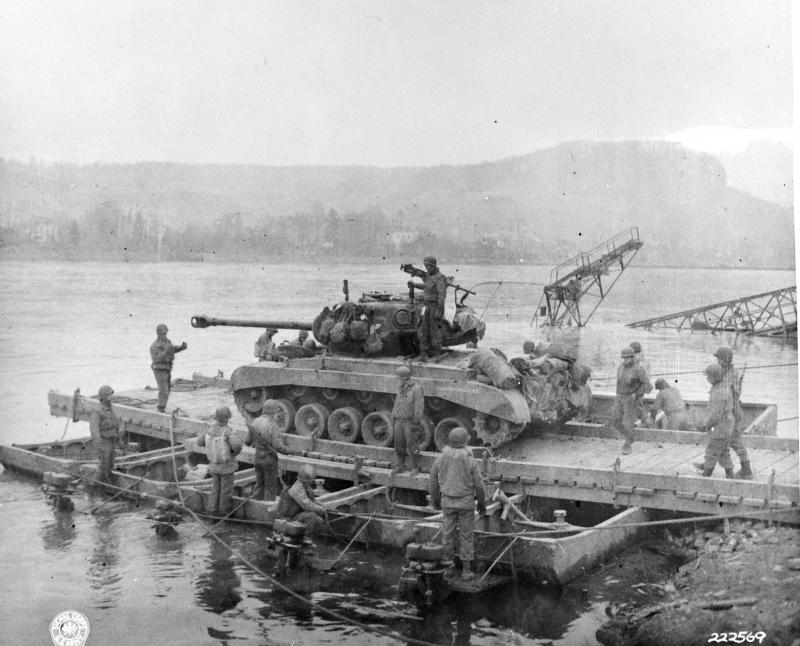
On December 22, 1944 — just six days into the offensive — orders were issued to ship the T26E3, the production name for what would become the M26, to Europe immediately. The first Pershings arrived in Antwerp in January 1945.
There were only 20 of them came to Europe at the Time.
The Duel in Front of a Cathedral
Of those 20 tanks, one ended up at the center of one of the most famous tank duels of the entire war.
On March 6, 1945, in the heart of Cologne, Germany, a Pershing from the 3rd Armored Division rolled toward the Cologne Cathedral. At the same time, a German Panther was doing exactly the same from the other direction. Neither crew knew the other was there.
The Germans spotted a Sherman first and destroyed it. A second Sherman tried to reverse and escape — the Panther shot out its tracks.
Then Pershing gunner Clarence Smoyer came around the corner.
He didn’t wait for his tank to stop. He fired on the move, landing three rounds into the Panther before it could turn its gun on him. The Panther crew never had a chance.
The whole engagement was captured on film by a U.S. Army cameraman who happened to be in the square. It’s one of the few tank duels in history you can actually watch.
Too Late, But Not Too Little
The M26 Pershing arrived in Europe too late to change the outcome of World War II — the war ended just months after its deployment. Only around 200 Pershings saw combat in Europe in total.
But the tank had a second life. In Korea, starting in 1950, the Pershing finally met its real test when North Korean T-34/85 tanks poured across the 38th parallel. American M24 Chaffees — light tanks — were hopelessly outmatched. The Pershing was rushed back into service and proved decisive, able to knock out T-34s at ranges the lighter American tanks couldn’t dream of.
It was retired in 1951, replaced by the M46 Patton — which was itself built on the Pershing’s chassis.
The Bigger Lesson
The M26 Pershing is often remembered as “the tank America should have had sooner.” That’s fair. But the reason it arrived late wasn’t a failure of engineering — American designers built a capable machine well ahead of time. It was a failure of institutional thinking. McNair’s doctrine held until the battlefield made it impossible to ignore.
The Pershing didn’t win the war. But it proved that when you finally listen to the men doing the fighting, you tend to build the right tools.