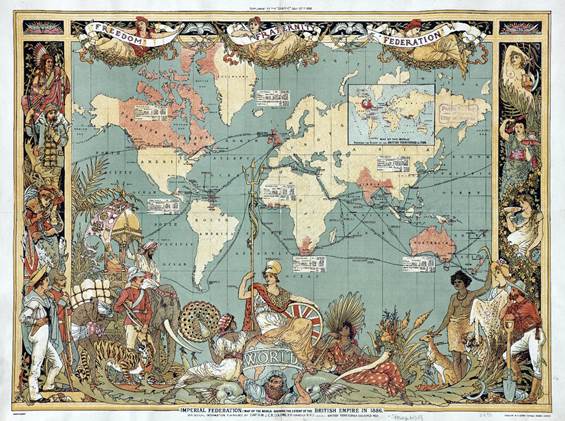
In the late 19th century, the British Empire stood as the largest empire in the history. Yet beneath the surface of global dominance, fears from the declining empire were on the rise. This tension gave birth to one of the most ambitious political ideas in history: the Imperial Federation
The Empire at Its Peak — and Under Pressure
By the 1880s, Britain ruled over 1/4 of the world’s land and population. It was a hegemon with a huge navy that protected trade routes from Canada to Australia. The phrase “the empire on which the sun never sets” fitted Britain more than Spain who started using the phrase.
But its decline was starting to show. Britain’s industrial superiority that helped its expansion was on the decline compared to new challengers:
- The United States had overtaken Britain in steel and oil production.
- Germany was advancing in chemicals, manufacturing, and military technology.
- Russia, with French investment and a vast population, was starting its rapid industrialization.
While the British Empire grew, its core economy started to lag behind.
Anxieties of a Shrinking Giant
Britain’s sense of insecurity was not limited to elites. The public began to question the stability of their empire. Their fear was not just about military or economic, but as a civilization; Would Britain end up as a single island in Europe like before?
Looking for a solution, the idea of the Imperial Federation emerged as a solution for all problems. Its goal: unify Britain and its self-governing colonies — Canada, Australia, New Zealand, and South Africa — into a single federation.
Seeley’s Vision of Greater Britain
John Robert Seeley, who wrote 1883 book, The Expansion of England, was one the visionaries for the Imperial federation. He argued that Britain needed to think politically, and posed a powerful question:
“If the United States can do it, why can’t we?”
Seeley believed that if Britain failed to integrate its colonies politically, it would go back to the insignificant past. He envisioned the Imperial Federation where Britain and its dominions were equal partners.
Why the idea was on the rise
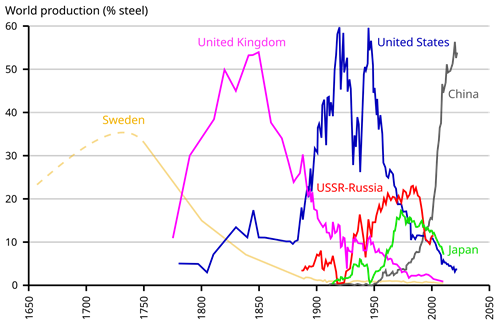
In the mid-19th century, Britain had no serious rivals. Its dominance in textiles, coal, and trade was unreachable. However, that dominance was on the decline as:
- The U.S. was producing more steel and had larger, more modern factories.
- Germany was building a navy and developing powerful industries.
- Russia was industrializing behind a wall of protectionist policies.
Not only that, Britain’s aristocratic traditions and smaller factory scale made it less productive to adapt to new technology. Even as the empire expanded, the metropolitan area was stagnating. Not only that, but the British island also lacked manpower and territory compared to other rivals.
Shift from Trade to Territory
The expansion of the empire wasn’t focused on more land. It was about trade and profit. For most of the 19th century, Britain was cautious about colonial overreach. Its real priority was maintaining and protecting the trade routes connecting to India.
But as rival powers gained strength, Britain became more aggressive:
- Africa saw rapid colonization after 1880, not for profit but to block French or German advances.
- Many of these new colonies were more about political need.
This expansion was defensive, not for economic opportunities. And it revealed that empire’s administrative power thinning out.
A Federation to Save the Empire
The Imperial Federation was conceived as a political answer to these pressures. It offered a way to consolidate power and population by creating a common parliament, shared foreign policy, and a unified defense strategy. Not only that the administration burden on British mainland will decrease.
The Federation promised:
- A stronger geopolitical presence.
- Shared military responsibilities.
- A long-term economic and cultural union among the English-speaking world.
In theory, it was the way to keep Britain’s global dominance.