Reason for Des Moines-Class Cruiser
During World War II, the U.S. Navy realized that its existing cruiser classes were reaching their design limits. When fighting against Japans Navy, Baltimore-class and New Orleans-class cruiser did not have what U.S Navay needed because their rate or fire was slow when they needed it. They needed a newer generation of ships to solve these problems and that was why Des Monies-class Cruiser was created.
Key motivations behind the Des Moines-class included:
- Improved firepower: To outgun enemy cruisers and support amphibious operations.
- Faster rate of fire: Thanks to new automatic loading systems (that cost a lot).
- Greater endurance: For sustained operations in vast ocean theaters.

Key Designs
The Des Moines-class cruisers were an evolution of Baltimore class with few tweaks.
General Specifications:
- Length: 716 feet
- Displacement: Approx. 17,000 tons (standard)
- Speed: 33 knots
- Crew: About 1,800 officers and enlisted men
Notable Innovations:
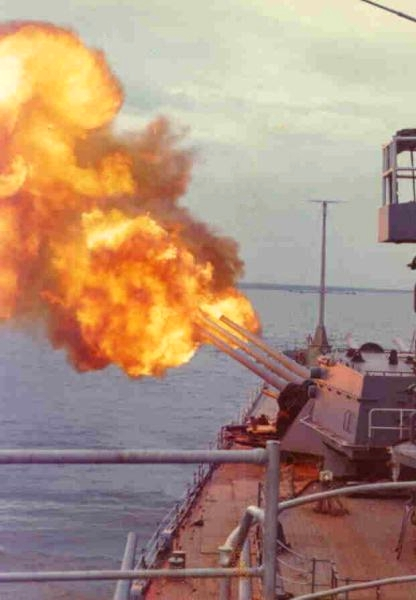
- Automatic 8-inch guns: The new Mark 16 8″/55 caliber guns had a revolutionary auto-loading system, allowing up to 7-10 rounds per minute — nearly more than double the rate of previous heavy cruisers.
- Advanced fire control: Radar-guided targeting systems increased accuracy in all weather.
- Heavier anti-aircraft defenses: Including twin 3-inch/50 caliber guns, a significant upgrade over the 40mm Bofors from WWII.
According to their plans for World War II, these ships could fire large amounts for both for shore bombardment and naval combat. The class was approved during the war, but the first ship, USS Des Moines (CA-134), but the first ship came into service 3 years after the war. Showing that for the weapons to be in service, timing needs to be right also.
Rise of Air Craft Carrier and Missile Age
Naval Battle in World War II showed shift in naval focus from all-big-guns that ruled the wave since HMS Dreadnaught. Battles like Midway and Philippine Sea proved that airpower could strike farther and faster than any gun cruiser ever could. Therefore, Aircraft Carrier and its escort ships that focused on anti-aircraft and anti-submarine became the new norm for naval power. Which resulted in ships like heavy cruisers and battleships becoming a relic of the past as now ships could outrange from a distance, decreasing the need to duel other surface ships or bombard shore targets. Not only that rise of Missiles that promised to do what even the most powerful naval guns could not: deliver pinpoint strikes at extreme ranges, including against high-speed aircraft and distant ships. These made Des Moines-Class cruisers to be no longer needed.
Commissioned ships
Therefore, Only three ships were completed out of the original planned twelve:
- USS Des Moines (CA-134) – Commissioned in 1948; served in the Atlantic and Mediterranean.
- USS Salem (CA-139) – Commissioned in 1949; now preserved as a museum ship.
- USS Newport News (CA-148) – Commissioned in 1949; saw combat during the Vietnam War.
The other planned ships were canceled post-war as military focus shifted to aircraft carriers and guided missile technology.
Service History: From Cold War Presence to Vietnam Fire Support
Because of change in technology, Des Moines-class cruisers only played small key roles in the postwar Navy.
- Cold War diplomacy: These crui sers often served as flagships for the 6th Fleet in the Mediterranean, projecting American naval power during tense geopolitical standoffs.
- Vietnam War: USS Newport News was the only ship of the class to see active combat. From 1967 to 1973, she provided naval gunfire support, famously bombarding North Vietnamese targets with deadly accuracy.
- Retirement: All ships were decommissioned by the early 1970s, with USS Newport News being the last, decommissioned in 1975.
USS Des Monies and Newport News where later scrapped but USS Salem is now in USS Salem Museum in Massachusetts unlike other ships.